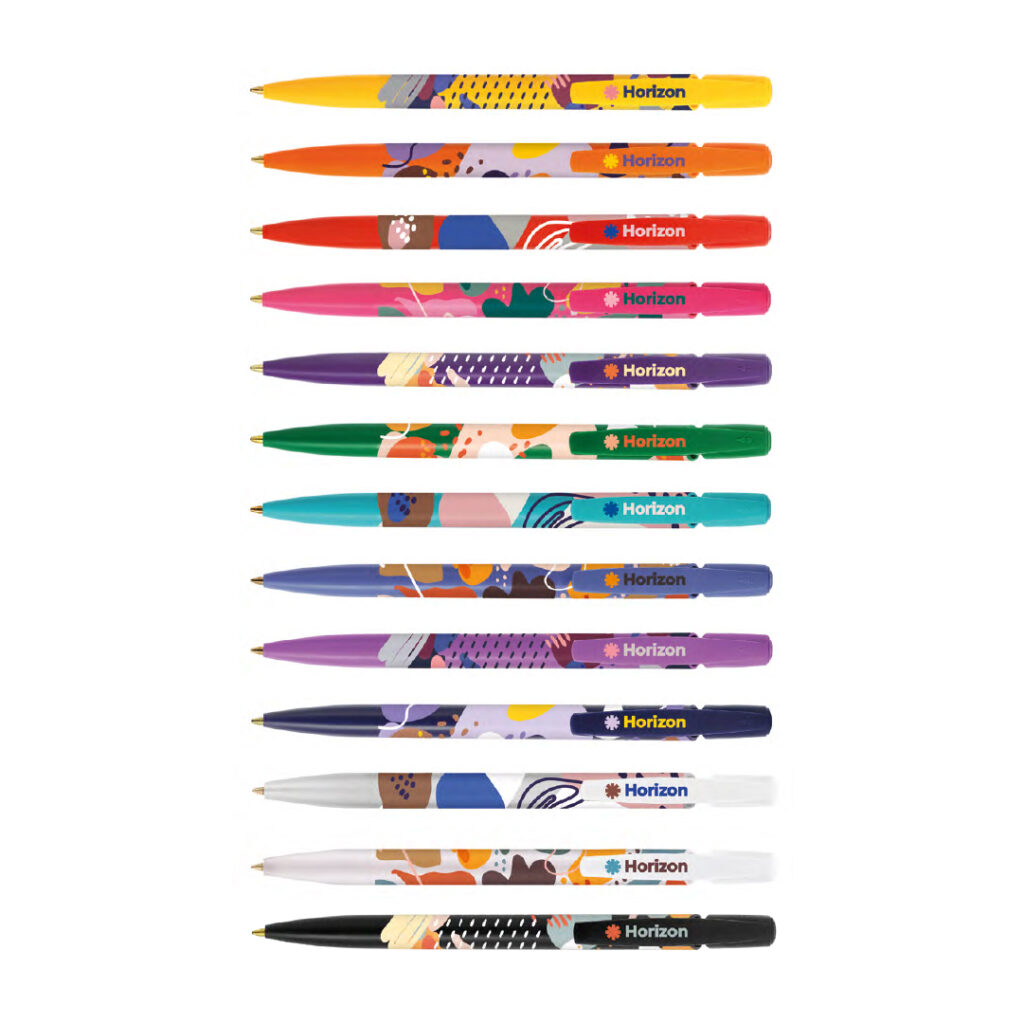
Why the BIC® Media Clic Is One of the Smartest Promotional Pens Promotional pens are everywhere. And that is exactly why standing out has become a challenge. Still, some pens manage to do just that. The BIC® Media Clic is a perfect example: a well-known classic that can be fully adapted to your brand. In this blog, we explain why this pen remains so popular and, more importantly, how organizations can use it in a smart and effective way. Promotional pens still work (when done right) A ballpoint pen may seem simple, but year after year the numbers say the same thing: promotional pens are among the most used and longest-kept giveaways. They don’t end up in a drawer — they sit on desks, in bags and in meeting rooms. The difference lies in execution. A standard pen disappears. A pen that writes well and looks good stays. What makes the BIC® Media Clic different? The strength of the BIC® Media Clic lies in freedom of choice. You can combine colors and printing options to create a pen that perfectly matches your brand identity. 1. Mix & Match colors You choose the color of: the barrel the clip the push button This results in hundreds of possible combinations. Subtle and professional or bold and playful? The choice is yours. 2. 360° printing Thanks to full 360° printing, you can do more than just add a logo. Patterns, illustrations or graphic accents increase visibility — from every angle. 3. Unbreakable clip The clip is designed for intensive use. No broken parts, no frustration. That means a longer product lifespan and more brand exposure. 4. Trusted BIC® quality BIC® is known for reliable writing comfort. The Media Clic writes smoothly, consistently and comfortably. A small detail with a big impact: a pen that doesn’t write well simply won’t be used. When is this pen a smart choice? The BIC® Media Clic is highly versatile. We frequently see it used for: Trade fairs and events – lightweight, affordable and easy to distribute Employee onboarding – practical and professional Schools and training programs – sturdy, reliable and recognizable Marketing campaigns – ideal as a branded giveaway with long-term visibility In short: any situation where your brand should be used and seen on a daily basis. Practical color advice (what really works) A few proven guidelines: Use your brand color for the clip or push button Combine it with a neutral barrel for balance For events: don’t be afraid of contrast For corporate environments: limit the palette to 2–3 colors Not sure what works best? Tailored advice always delivers the best result. Conclusion: simple, smart and effective The BIC® Media Clic proves that a promotional item doesn’t need to be complicated to work. With smart personalization, strong quality and an attractive price, it remains one of the most popular pens for companies and organizations. Want to know which combination best fits your brand, or looking for a price indication? 👉 We’re happy to think along and help you choose.
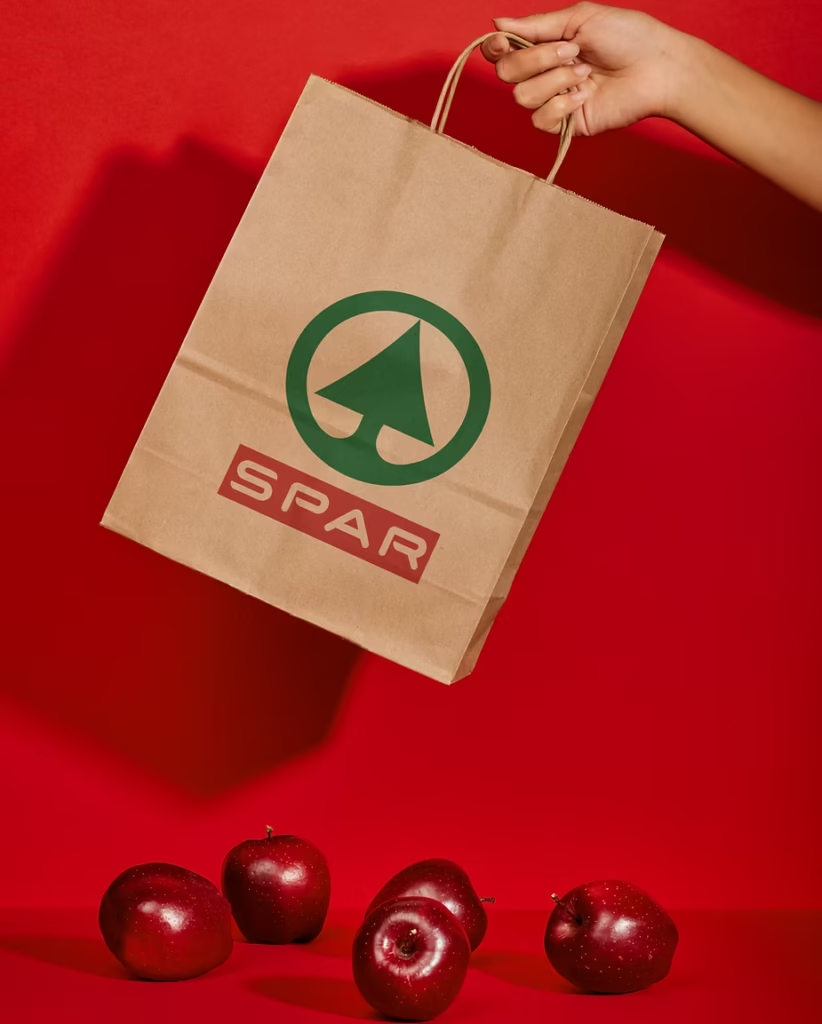
European Made Paper Bags & Cups – Reliable Packaging Without Compromise In today’s packaging market, quality, origin and reliability make the difference. Brands are increasingly looking beyond low-cost imports and choosing solutions that offer consistency, traceability and long-term value. At Eurologica, we focus on 100% European-made paper bags and paper cups, produced under strict quality standards and with full control over materials, production and lead times. By working exclusively with European manufacturing partners, we offer packaging that not only looks premium, but also performs reliably, order after order. No shortcuts, no uncertainty. Just packaging that supports your brand. All production takes place in Europe. That means: Shorter and more reliable supply chains Consistent quality standards Compliance with European environmental and labour regulations There is no Asian mass production involved. Printing and assembly are done on modern machinery, including a latest-generation Italian flexo press installed in 2024. High-quality European paper only Quality starts with raw materials. The paper and cardboard used come exclusively from renowned European paper mills: Austria Finland Sweden Estonia Italy Low-grade paper from outside Europe is deliberately avoided. The difference is not only visible, but also technical: better fibre composition, higher durability, improved elasticity and superior print results. Simply put: less paper, better performance. The product range includes both functional and premium packaging solutions. This covers kraft paper bags with flat or twisted paper handles, luxury paper bags finished with PP, cotton or ribbon handles, paper cups from 4 oz up to 16 oz, and PP woven and non-woven carrier bags. All options are designed for professional branding with sharp, consistent print quality. To ensure efficiency and reliable quality, production starts from clearly defined minimum quantities: approximately 5,000 units for kraft paper bags, 500 units for luxury paper bags, and from 16,000 units for paper cups, depending on size. PP woven and non-woven bags start from 15,000 to 20,000 units. Average production lead time is 21 to 30 days, depending on specifications. This production setup is already trusted by brands across Europe, including several in Belgium. Consistent quality, reliability and repeatability are the key reasons customers continue to choose this production model. Choosing European-made packaging is more than a logistical decision. It is a brand statement that stands for transparent origin, higher perceived value, reduced supply and quality risks, and alignment with sustainability and CSR objectives. At Eurologica, we believe packaging should strengthen your brand — not compromise it. Interested in samples or pricing? We’re happy to advise and provide samples so you can experience the quality firsthan
“Made in Europe” has become a reassuring phrase. It suggests quality, responsibility and control in a global market that often feels unpredictable. For many companies, origin has shifted from a minor detail to a factor that genuinely influences purchasing decisions. Yet while the label sounds straightforward, the reality behind it is far more complex. A legal definition, not a marketing slogan Within the European Union, product origin is defined by customs legislation, not by branding preferences. A product may be labelled as European when it is entirely manufactured within Europe, or when the final substantial and economically justified transformation takes place there. That distinction matters. Many products rely on globally sourced components and are assembled within Europe. Assembly alone does not automatically justify a “Made in Europe” claim. The decisive factor is whether the final production step fundamentally changes the product’s nature or function. This is where interpretation becomes unavoidable and where misunderstandings often arise. Where confusion begins In commercial communication, “Made in Europe” is sometimes used as a broad quality label rather than a precise statement of origin. For companies that deliberately choose European production, this creates tension. When everything is presented as European, the distinction loses its meaning. As a result, buyers become sceptical. They ask where products are made, which steps happen locally and what “European” actually refers to in practice. Those questions are not inconvenient; they are necessary. Clear and transparent answers matter more than ever. Why European production offers more control What consistently distinguishes European manufacturing is oversight. Producers within Europe operate under strict regulations covering product quality, safety, traceability and liability. These requirements are enforced and monitored. For large production volumes, this level of control is critical. Errors can be identified more quickly, corrective actions are feasible and responsibilities are clearly defined. Compared to long and fragmented supply chains, European production offers a higher degree of predictability. That predictability has become a strategic advantage. Is Made in Europe automatically sustainable? The honest answer is no. European production benefits from stricter environmental legislation and shorter transport distances, but sustainability ultimately depends on how a product is made. Energy sources, material choices and waste management vary significantly between manufacturers, even within the same region. Overstating sustainability claims undermines credibility. Explaining production choices with nuance strengthens trust. What this means for companies today For many companies, choosing Made in Europe is less about image and more about certainty. It means clearer responsibility when something goes wrong, more predictable lead times and products that can be reordered without unexpected disruptions. In a business environment where reliability increasingly outweighs marginal cost savings, origin is no longer a label. It is a strategic decision.